
Transition Center Status Records
Marion County sources do not support a simple claim that the Transition Center is now an active custody facility. The still-live county program page describes a 144-bed minimum-security jail alternative for work release, local court sentences, and supervision-violation placements. Yet an October 8, 2024 Public Safety Coordinating Council packet says staff were reassigned to the jail and the building was planned for conversion to a Stabilization Center.
That official-source conflict must stay visible. Describe placements as historical unless MCSO confirms current operations at 503-581-1183. A past participant could have moved from the jail to this program, worked in the community, completed a local sentence, returned to supervision, or been routed elsewhere. None of those paths should be imported into a current record without proof.
Confirm Transition Center Placement
Start with Marion Jail Viewer because Transition Center participants historically remained within the MCSO data path. Search the person across a broad booking range and open the booking detail. The local rule is unusual: Jail Viewer says a blank Location means the person is housed at the Transition Center. A blank location therefore cannot be read as freedom.
- Match the booking by name, date, booking number, and inmate ID.
- Read actual Release Date separately from Scheduled Release Date.
- Apply the blank-location convention only as the Viewer states it.
- Call 503-581-1183 or the jail at 503-588-8595 to verify the current meaning and facility status.
- Request the release sheet when destination or release reason matters.
The broader Marion County released inmate search explains when to check ODOC, federal, immigration, or court sources after a county booking ends.
Marion County Transition Center Record Fields
Jail Viewer is more useful than a simple current roster because it can return older bookings and separates an actual release from a scheduled date. Still, the site warns that information changes and is not guaranteed. A missing result can stem from spelling, a narrow booking range, an alias, another custodian, sealing, youth status, or lag. Absence should not be stated as proof of freedom.
| Field | What it establishes |
|---|---|
| Booking number | The specific county custody episode |
| Booking date | When that episode began in the database |
| Release Date | The recorded end of that MCSO booking |
| Sch Rel Date | A future estimate or calculation, not an exit |
| Location | A custody-placement clue, subject to the Transition Center convention |
| Charges and court case | The legal matter tied to the booking, not the release destination by itself |
Keep the three dates distinct: scheduled release, actual physical release from MCSO, and any later supervision or sentence expiration. They can all differ and still be accurate.
Transition Center Contact Check
The phone check is essential because the live descriptive page and later planning packet point in different directions. Do not assume that an older program page proves an active bed, active intake, or present release process.
Marion County Transition Center
3950 Aumsville Highway SE
Salem, Oregon
503-581-1183
Current custody operations require confirmation
Marion County Jail
4000 Aumsville Highway SE
Salem, Oregon
503-588-8595
Staffed 24/7
The official Transition Center page preserves the historic program description.
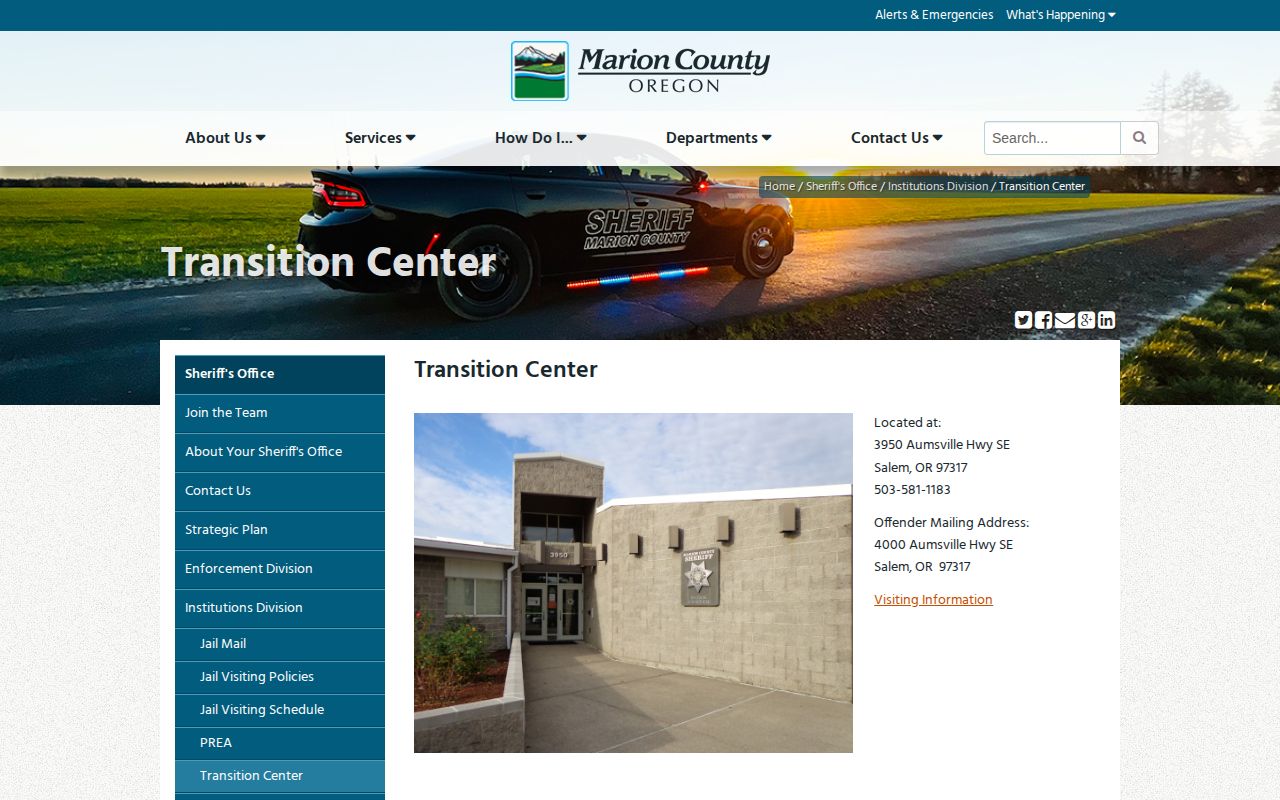
The image documents the county description, while the later packet supplies the operational caveat.
Request Marion County Transition Center Records
Save the booking number, inmate ID, displayed dates, and record URL before contacting MCSO. A focused request should name the person, give the booking number and approximate booking date, and ask for the releasable booking or release sheet. Specify actual release date and time, release code or reason, authorizing court or agency, and receiving agency or destination if those fields are maintained.
Incident reports are separate. MCSO warns that a criminal-charge report may be unavailable until the case closes, and some material may require a court order or subpoena. That limit does not automatically decide whether basic booking and release facts may be disclosed. Ask the records custodian to cite any exemption and release nonexempt parts. Search time, redaction, and media format can affect cost, so request an estimate when cost is a concern.
Oregon Public Records Law begins at ORS 192.311. The response framework includes acknowledgment and completion targets, but clarification, fees, impracticability, and exemptions can pause or change those periods. Do not treat them as a flat delivery promise.
Transition Center Program History
Historically, the Transition Center operated as a minimum-security alternative to jail or prison. The county described 144 beds and categories that included work release, court-sentenced participants, and placements tied to parole or probation violations. DeMuniz Resource Center services were co-located, creating a visible bridge between custody, supervision, and practical reentry support.
Those figures are historical context, not a current availability claim. The planning packet described moving staff to the Marion County Jail and future use of the building as a Stabilization Center. Publication should preserve both sources instead of silently choosing the older page.
The historic participant groups explain why one label does not reveal the legal basis for placement. Work release involved a county custody arrangement with approved work activity. A court-sentenced participant remained subject to the judgment. A person placed after a parole or probation violation remained tied to the supervision case. Each path could end with return to the community, renewed supervision, movement back to jail, or another authorized placement. The booking and supervision records must identify which path applied.
Marion County Transitional Services adds another local layer. The unit tracks release dates, develops plans for local-control releases, and coordinates some intercounty transfers. Those functions can help identify the responsible supervision office after a historical Transition Center placement. They do not turn a program record into proof of full discharge. A person may have left the building while parole, probation, post-prison supervision, or a court sentence continued.
The official conflict also affects search language. A Jail Viewer blank Location is a documented historic convention for Transition Center placement, but it should not be used to claim that the building still accepts participants. Preserve the booking number and displayed dates, then ask MCSO what that notation meant for the specific episode. A dated phone confirmation is more reliable than repeating an undated operational assumption.
Marion County Transition Center Transfer Codes
The exchange-hub role is the most important local caution. A status code may explain why the county record ended, but it cannot replace the actual disposition. CITE means cite and release. OSCD concerns Oregon State Corrections, while SENOSC identifies a person sentenced to Corrections and awaiting transfer. PARVIO and PROVIO flag parole or probation violations. Those are different events with different follow-up offices.
When ODOC is the next custodian, search Oregon Offender Search by name or SID. For a U.S. Marshals hold, consult the federal court record and District of Oregon office because USMS has no public real-time locator like BOP. Use the BOP Inmate Locator for a federal prison sentence. For an immigration handoff, use ICE's detainee locator and reporting line. An INS code does not establish that the jail has a standing ICE contract.
Note: Match every status statement to a named custodian and one specific booking or prison episode.
Transition Center Release Meaning
A move from the jail to the Transition Center historically was not a community release. Work release allowed approved activity outside a secure setting under program rules, while a supervision-violation placement could function as an alternative to jail or prison. Both still involved legal control. A later return to the community could also carry probation, parole, or post-prison supervision.
For a past event, join the booking detail to the MCSO release sheet and court or supervision record. Ask which facility held the person, when that placement ended, and what agency or program received the person next. If a blank Location is the only clue, preserve it as a placement notation rather than converting it into an exact address or release event.
For a current event, call. No researched source establishes a current intake schedule, release time, public waiting area, or active capacity. Those gaps must remain gaps until MCSO gives a dated operational answer.
Public Record Search
Sponsored Results
Verify Transition Center Operations
A current-status call should produce a narrow, dated answer. Ask whether the building presently accepts custody placements, whether Jail Viewer still uses blank Location for that placement, and which office now owns older release records. Record the staff title and confirmation date. If MCSO says the building has changed functions, keep the historical booking language tied to the earlier custody episode rather than describing the new program as a continuation of the old Transition Center.
The October 2024 county public-safety packet and the still-live program page can both remain useful when their dates and purposes are clear. One documents a planned staffing and building change. The other describes the historic correctional model. Neither source alone establishes today's intake, bed use, release procedure, or public contact route.