
Oregon State Penitentiary Release Paths
Oregon State Penitentiary is an Oregon Department of Corrections prison, not a Marion County jail. A person leaving OSP may transfer to another ODOC institution, enter short-term transitional leave, begin parole or post-prison supervision, or complete the custodial part of a sentence. Only the last three may involve a physical move outside prison, and none automatically means the whole sentence or supervision term has ended.
A facility change in Oregon Offender Search is a transfer clue. It is not an OSP release to the community. A projected release date is also prospective. Board hearings at OSP can set, affirm, defer, reduce, postpone, or decline a parole date in cases under Board authority, but a hearing or favorable order does not prove that the person passed through the gate. Confirm the physical event through ODOC status, VISOR, and an official record when precision matters.
Confirm OSP Physical Release
Start with Oregon Offender Search. OOS covers people currently in ODOC custody or a local Community Corrections office. Search by first, middle, and last name or SID. The official help allows an asterisk within or at the end of a name, but not in an SID. Open the detail through the SID and compare identifiers before relying on the match.
- Identify the person by name, SID, aliases, and birth month or year where displayed.
- Read current location and status before reading any future date.
- Keep the projected release date separate from a recorded physical release or supervision status.
- Check VISOR for a reported custody event and BOPPPS for a final order when Board authority applies.
- Request the ODOC record when OOS no longer shows a fully discharged person.
OOS is not a permanent history and labels can vary by record. Save the observation date. The countywide Marion County released inmate search explains how state and county paths differ.
OSP Offender Search Evidence
OOS may show names and aliases, SID, birth month and year, court name, current location, and offenses tied to the current incarceration. It can also route a user toward the current release-date calculation. Yet OOS states that it is not an official record. A person on parole or post-prison supervision may remain visible through a Community Corrections location, while someone who fully discharged may disappear.
| Evidence | Correct reading |
|---|---|
| OSP location | Current prison placement, not a release |
| New prison location | Transfer within ODOC |
| Projected release date | A calculated future date that can change |
| Community Corrections status | Physical release with ongoing legal supervision |
| Discharge record | Official evidence that the applicable custody or supervision term ended |
Short-term transitional leave is a community placement while the person remains legally an adult in custody. It should not be called an unconditional discharge.
OSP Records and Contact
Facility questions belong with Oregon State Penitentiary. Official offender and discharge records belong with ODOC public records. The Board of Parole and Post-Prison Supervision keeps its own orders. Contact the custodian that created the record instead of asking MCSO for a state-prison release.
Oregon State Penitentiary
2605 State Street
Salem, Oregon
503-378-2453
Operator: Oregon Department of Corrections
ODOC Central Information
503-945-9090
Use the official public-records portal for offender, movement, physical-release, or discharge records.
The official ODOC prison locations page identifies OSP within the statewide prison system.
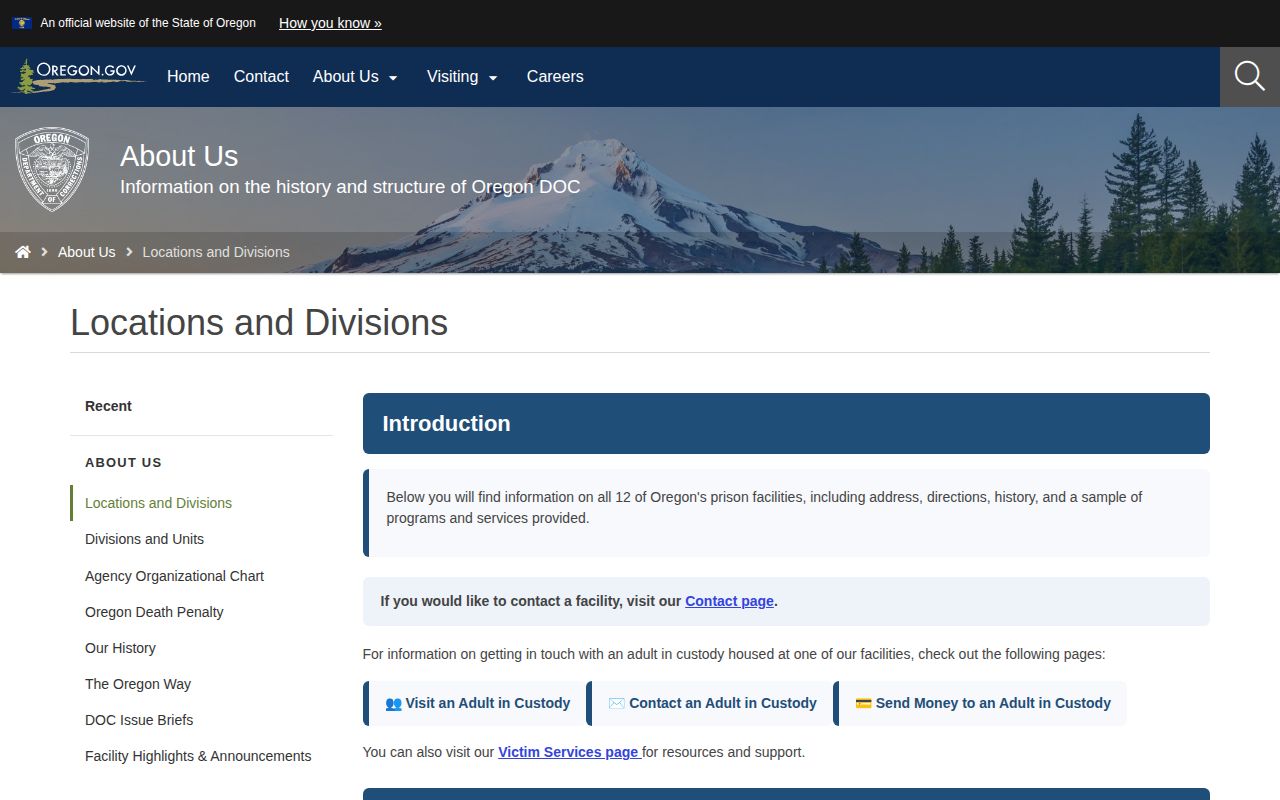
The captured ODOC page confirms which agency controls OSP placement and release information.
Request OSP Discharge Records
When OOS is incomplete or a fully discharged person no longer appears, use ODOC public records. Identify the person by full name and SID if known. Give the relevant date range and ask for precise public fields: admission, institution movements, physical release, release type, discharge, projected-date history, and the public portions of the Pen Pack.
A Pen Pack may include face sheets, a photograph, judgments or sentence orders, and some discharge, revocation, or sanction material. Protected medical, treatment, victim, and security information should not be requested as though it were public. Ask the agency to identify any exemption and release segregable nonexempt portions.
If a Board decision controlled parole, request the final order from BOPPPS by name, SID, and approximate hearing date. A final order can distinguish physical release, parole release, and supervision expiration. Those dates may differ.
OSP Maximum Custody History
OSP is ODOC's oldest prison and its primary maximum-security institution in Salem. That history explains why old and current records may refer to several sentencing systems. Offense date and governing law can change whether BOPPPS has a release-setting role. Many people convicted of offenses after November 1, 1989 have determinate guideline sentences for which the Board does not set the prison release date, though it may set post-prison supervision conditions.
For cases within Board authority, OSP may host a hearing. The official calendar is event based. Notices can change, and observation requires advance contact and ODOC screening. Hearing labels are not interchangeable. A prison-term hearing, exit interview, murder review, parole postponement, or future-disposition hearing answers a distinct legal question.
Board records can carry several dates that answer different questions. A physical release date concerns departure from prison custody. A parole release date concerns the legal start of parole under the order. Post-prison-supervision expiration concerns the later end of supervision. The Board's sample order warns that parole and physical release dates may differ. Reading only the first date on an order can therefore produce the wrong status.
Sentence computation also changes by governing law. ORS 421.121 permits earned-time reductions only for eligible adults and contains conditions and exclusions. Measure 11 minimums under ORS 137.700 are not a general eighty-five-percent rule. The listed mandatory minimum must be served unless a supported statutory exception applies. The signed judgment, current statute, and ODOC calculation control the individual case.
Historical depth makes the signed judgment, current statute, OOS status, final Board order, and physical-release record a stronger chain than any single screen. If OOS no longer returns a fully discharged person, a focused Pen Pack or discharge-record request preserves the older custody narrative.
Marion Transfers and OSP Records
A Marion Jail Viewer code such as SENOSC can signal that a county booking ended because the person was sentenced to Oregon Corrections and awaited transfer. That is a routing clue to search OOS. It does not prove arrival at OSP or later release from OSP.
Three dates must remain separate. A projected release date is a calculation that can move. A physical release date records departure from the institution or prison custody. A parole, post-prison-supervision, or sentence expiration date marks the end of a later legal term. A person can be physically outside OSP while still listed under Marion County Community Corrections.
Changes can follow an amended judgment, presentence-credit review, earned-time eligibility, misconduct sanctions, another sentence, a detainer, Board action, or short-term transitional leave. Oregon law does not support one percentage for all sentences. Measure 11 mandatory minimums under ORS 137.700 generally require the full listed minimum, while ORS 421.121 applies only to eligible sentences and has conditions and exclusions.
Note: Preserve the date and exact label shown by each official system before describing an OSP release.
OSP Hearings Are Not Releases
The Oregon Board of Parole and Post-Prison Supervision publishes a live hearing calendar, and notices may identify OSP. A hearing can precede release, but it is not gate evidence. Even a decision that sets or affirms a parole date may include conditions, later review, or a change before physical release. Obtain the final order rather than treating the calendar title as the result.
After an OSP physical release, OOS or VISOR may show supervision. Parole is conditional release under Board authority. Post-prison supervision is a community supervision term that follows many prison sentences. Discharge means the applicable legal control ended. Use Marion Community Corrections only when the person is assigned locally, since the supervising county may differ from the prison county.
For a final check, pair the ODOC event with the Board order when applicable and the supervising office record. That states exactly what ended and what, if anything, continues.
Public Record Search
Sponsored Results
OSP Board Record Check
No verified official person-name results database replaces the Board order. When a hearing at OSP may have affected release, request the final order from BOPPPS with the person's name, SID, and approximate hearing date. Read the outcome language closely. Set, affirmed, deferred, postponed, reduced, rescinded, and continued describe different actions, and none substitutes for a later ODOC physical-release status.
The live calendar remains useful for identifying the hearing date and institution. Recheck it because events can move. Public observation of an in-prison hearing requires advance contact and ODOC screening, but attendance does not establish that a person was released. The order, OOS or VISOR event, and ODOC record answer separate parts of the release history.