
Marion County Projected Versus Actual Release
A projected release date is calculated before the event. Oregon Department of Corrections calls it a Projected Release Date, or PRD. It draws from the signed judgment, the sentence start, concurrent or consecutive terms, presentence custody credit, mandatory minimums, earned-time eligibility, sanctions, and later legal changes. The figure can move as those inputs change. It should always be quoted with the date it was observed.
An actual release date looks backward. Marion County Jail Viewer places “Release Date” beside “Sch Rel Date,” which makes the difference visible. A populated actual date confirms that the county booking episode ended, subject to the viewer's accuracy warning. It does not prove a return to the community. The person might have transferred to ODOC, another county, federal custody, immigration custody, or another placement.
Marion County Release Dates by Custody
Pretrial detainees usually have no fixed release date because the case, bail status, holds, and court orders remain unresolved. A local-sentence prisoner may have a scheduled date calculated by county staff. An Oregon prison sentence belongs to ODOC's calculation system. A parole hearing date is different from all three. It marks a proceeding, not the date of physical release.
| Person's status | Useful date source | Main limit |
|---|---|---|
| Pretrial in Marion County Jail | Jail Viewer and court orders | No fixed date may exist. |
| Serving a county sentence | Jail Viewer and Release Office | The county does not publish its formula online. |
| Serving an ODOC sentence | Oregon Offender Search PRD | The date can be recalculated. |
| Within Board parole authority | Final Board order plus OOS | A hearing or parole date is not physical release. |
| Already released | Actual jail, DOC, or discharge record | Supervision may continue afterward. |
This division prevents a common error. A Salem prison record may concern Oregon State Penitentiary, OSCI, or SCI, but it is not a Marion County Jail sentence. Each custodian uses its own records and computation rules.
Note: A pretrial court date is not a release date because bail, holds, and later orders can still control custody.
Find Marion County Projected Release Dates
Start with the custody system, then work from the most direct official record. Names alone can match several people, so save the booking number, inmate ID, SID, and case number when available. Read labels precisely. “Scheduled,” “projected,” “physical release,” “parole release,” and “supervision expiration” are not interchangeable.
- Identify whether Marion County, ODOC, a federal agency, or another custodian holds the person.
- For county custody, search Jail Viewer by name and a broad booking-date range. Open the right booking.
- Read Sch Rel Date separately from Release Date and Location. Call the Release Office if the calculation is unclear.
- For state custody, search OOS by name or SID and note the current release date plus the observation date.
- Obtain the signed and amended judgment to check sentence structure, custody credit, and controlling law.
- Check Board authority, other cases, and detainers before treating the projected date as stable.
- After the date, verify the actual event through Jail Viewer, OOS, VISOR, or the official record.
The Marion County released inmate lookup supplies the full post-release path when a person has already left the active roster. For a future prison date, OOS remains the public source that ODOC identifies for its current calculation.
OOS Marion County Release Date Lookup
Oregon Offender Search accepts first, middle, and last name or SID. Official help allows an asterisk within or at the end of a name, but not within an SID. Open a possible match by SID and confirm the details. OOS covers people currently in ODOC custody or a local Community Corrections office. It is not a complete historical discharge database.
The live interface can vary by record, and its help does not promise a stable PRD label in every result. ODOC's sentence-recalculation material still identifies OOS as the official public place to view the current release date. Capture the exact label and the date viewed. A person on parole or post-prison supervision may remain visible, while someone fully discharged may disappear.
The official ODOC offender-search information describes the tool's present scope.
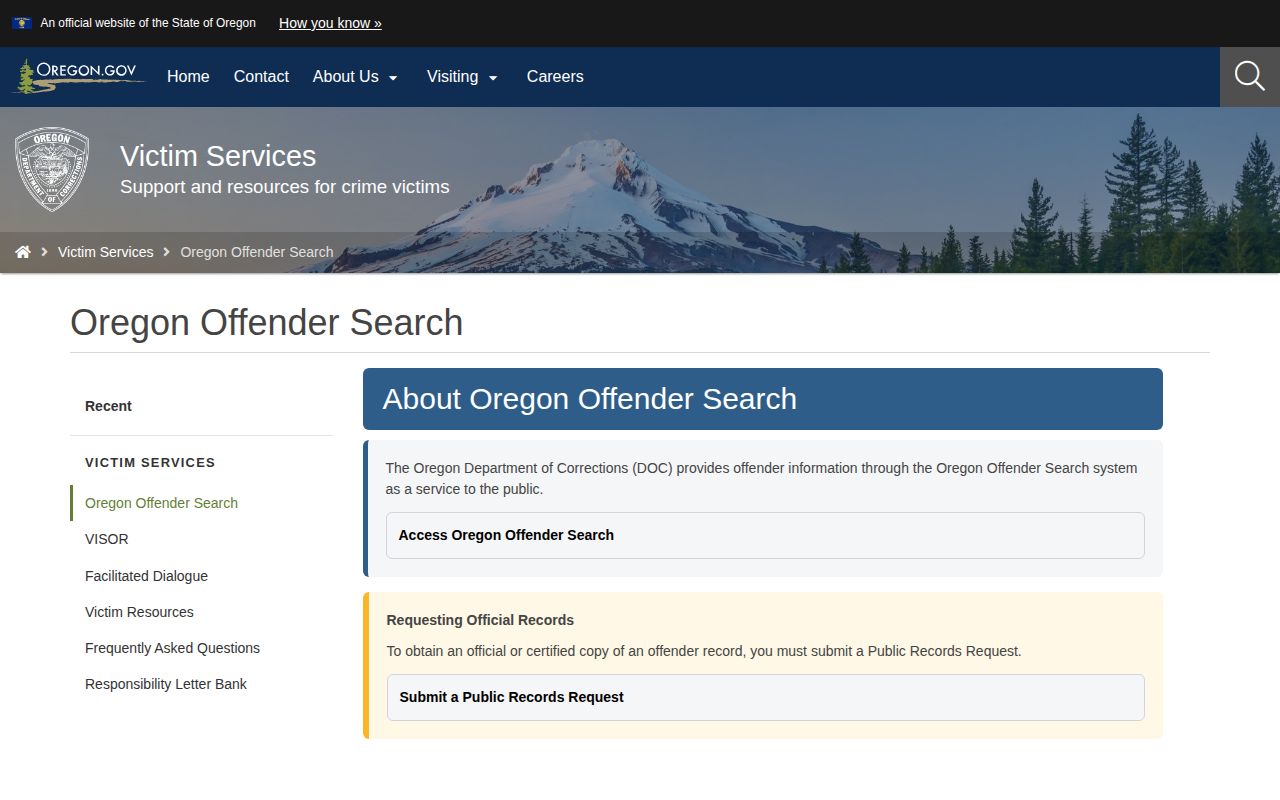
The image identifies the state search channel. A live person record is still needed to see the fields currently supplied for that individual.
Note: Record the OOS label and observation date because the displayed Marion County release calculation can change after review.
Marion County Release Date Earned Time
ORS 421.121 authorizes earned-time reductions for eligible adults who meet case-planning and conduct requirements. Not every person qualifies. Offense type, offense date, exclusions, minimum confinement, and the governing version of the law matter. For an eligible non-Measure-11 DOC felony term, the current statute can authorize a reduction of up to 20 percent, subject to those limits. That possibility is not a promise of a particular date.
County jail computation is separate. Marion publishes a scheduled release field but did not publish a formula in the researched pages. ORS chapter 169, court credit, and county classification practices may affect local custody. Do not subtract an ODOC earned-time percentage from a county jail sentence. The Marion County Jail Release Office at 503-588-8560 is the correct operational source for a local calculation.
Note: Use the judgment, current statute, and agency calculation together because no single percentage establishes a Marion County release date.
Measure 11 Marion County Release Dates
Measure 11 is not an 85 percent rule. ORS 137.700 sets mandatory minimum prison terms for listed offenses and restricts release mechanisms. The person generally serves the entire listed minimum, and ORS 421.121 earned time does not reduce that minimum. Calling the rule “about 85 percent” creates a false projected release date.
Individual cases still require the judgment and the law that applies to the offense and person. ORS 137.712 contains case-specific exceptions, while ORS 137.707 addresses provisions affecting certain young defendants. ORS 137.635 can also require service of an entire sentence for qualifying repeat serious felonies. Physical release may then be followed by post-prison supervision, so sentence-end arithmetic does not show when all legal control ends.
- Mandatory minimum
- The least prison term required by the controlling statute.
- Earned time
- A conditional term reduction available only when the person and sentence qualify.
- Presentence credit
- Credit for qualifying custody served before the prison sentence began.
- Post-prison supervision
- Community supervision that can follow physical release from prison.
Why Marion County Release Dates Change
A projected date can move in either direction. Some changes arise from conduct and credit. Others come from a new judgment, another sentence, a detainer, or a Board order. Short-term transitional leave also should not be mistaken for discharge because the person can remain legally in ODOC custody while outside a prison.
| Factor | Possible effect | Record to check |
|---|---|---|
| Amended judgment | Changes term, credit, or sentence structure | Signed court order and ODOC calculation |
| Earned-time eligibility or loss | Moves an eligible date under current law | OOS and official DOC record |
| Concurrent or consecutive case | Changes which term controls | Judgments for all linked cases |
| Detainer or hold | May cause transfer instead of community release | Custodian's disposition and receiving-agency record |
| Board decision | May set, affirm, defer, or postpone a parole date | Final BOPPPS order |
| Law or recalculation | Revises sentence credit or release computation | ODOC notice, OOS, and judgment |
Oregon Recalculation and Marion Releases
The Oregon Supreme Court's July 2025 Torres-Lopez v. Fahrion decision illustrates why static calculators fail. ODOC reviewed qualifying sentences imposed or reimposed on or after August 1, 2015 for overlapping presentence custody credit under ORS 137.370(4). The judgment must expressly permit the relevant credit. ODOC says qualifying reviews are automatic, OOS reflects the updated date, and VISOR can send notices about relevant changes.
That review does not create a general rule for every Marion County prisoner. It applies only when the sentence and judgment meet the stated conditions. Save the old and new date, the observation date, and any agency notice. If the calculation is disputed, the signed judgment, counsel, sentencing court, and ODOC process are more useful than an uncited online calculator.
Note: The 2025 recalculation is a case-specific legal development, not a new percentage that can be applied to every sentence.
Marion County Projected Parole Dates
The Oregon Board of Parole and Post-Prison Supervision has release-date authority only in the cases assigned to it by law. Its live hearing calendar shows events, not a list of actual releases. A Prison Term hearing can set or decline to set a projected parole release date. An Exit Interview can affirm or defer one. Other hearing types may reduce, postpone, rescind, or continue a date. The label and the final order matter.
For many offenses committed after November 1, 1989, determinate sentencing means the Board does not hold a release hearing or calculate the prison release date. It may still set supervision conditions for parole or post-prison supervision. A calendar entry therefore should never be substituted for ODOC's calculated PRD. Likewise, a favorable hearing result may carry conditions or later review and does not prove that the person walked out of the institution.
When Board authority applies, request the final order by name, SID, and approximate hearing date. An order may distinguish physical release date, parole release date, and post-prison-supervision expiration. The Board's own sample warns that physical and parole release dates can differ. After reading the order, check OOS and VISOR for the later custody event, then obtain an ODOC record if the result remains uncertain.
Marion County Release Date Records
Public tools are starting points, not certified calculations. For a county sentence, save the Jail Viewer booking number and ask the Release Office to explain the scheduled date. A written MCSO request can seek the booking and release sheet, actual release time, release reason, authorizing court, and receiving agency. This is especially important when a hold or transfer may control the outcome.
For an ODOC sentence, request the official offender record with the SID, relevant date range, admission, institution movement, PRD history, physical release, release type, and discharge fields. A fully discharged person may no longer be returned by OOS. For a Board-controlled date, obtain the final BOPPPS order rather than relying on the hearing calendar. Each record answers one part of the date history, and the signed judgment remains the starting legal instruction.
Confirm Marion County Actual Release Dates
Once a projected date arrives, return to the source. A county booking should show an actual release field or be confirmed by MCSO. A prison release should be checked through OOS and, where needed, an official ODOC discharge record. A Board order can distinguish physical release, parole release, and supervision expiration, but a hearing calendar cannot prove that the person left.
Oregon VISOR can provide a prospective alert. The Marion County VINE inmate check explains its current account or guest confirmation flow. No current PIN field appears in Oregon's portal. Alerts can lag and remain agency-specific, so keep them as a prompt to verify, not as the final source record.
Note: A transfer ends one placement but may begin another, so always name the custodian when stating that a release occurred.